

What Is AI SEO? A Complete Beginner’s Guide (2026)
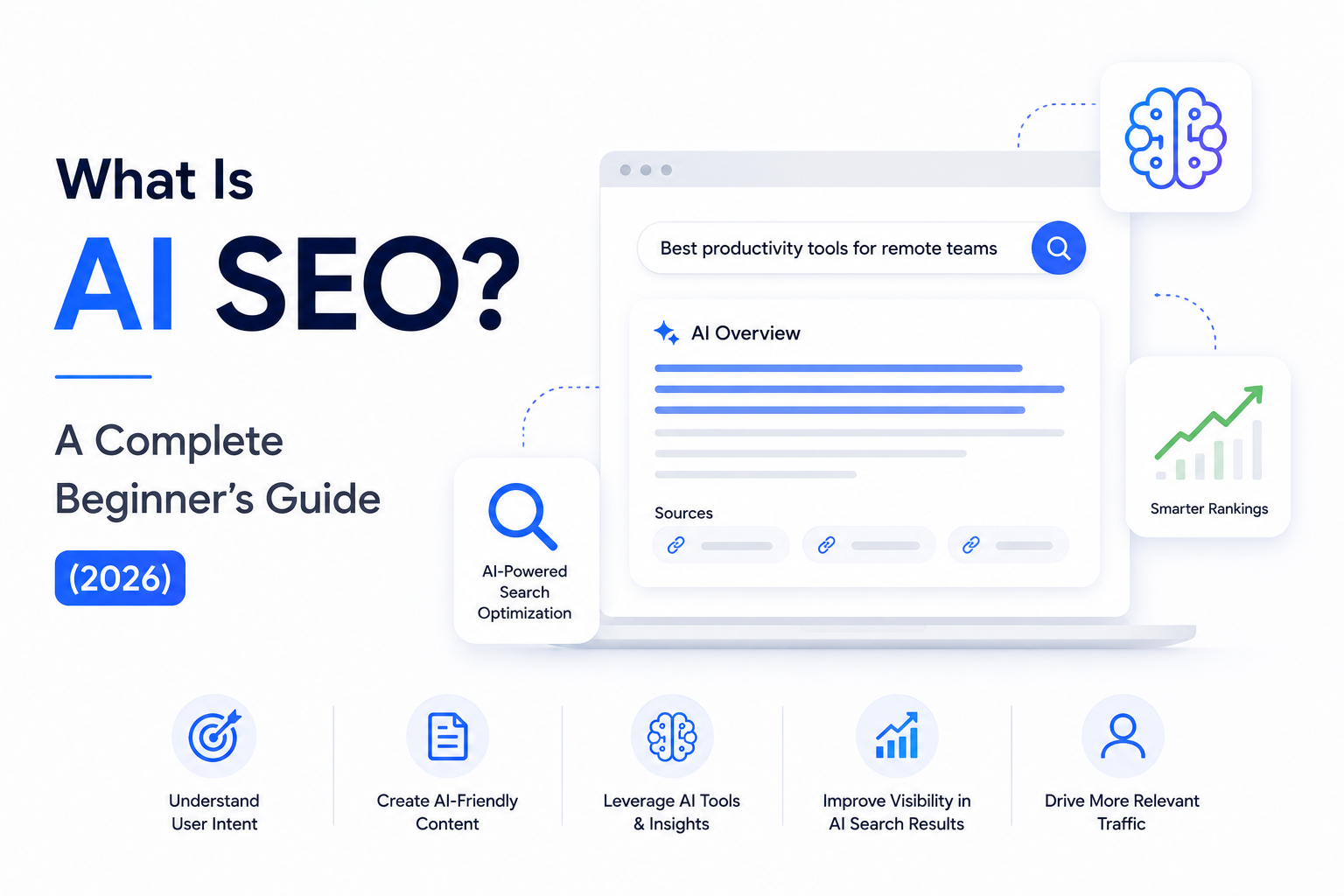
AI SEO is the practice of optimizing your website so it gets cited and recommended by AI search systems like Google AI Overview, ChatGPT, Gemini, Perplexity, and Bing Copilot — not just ranked on Google’s traditional search results. It combines classic SEO fundamentals with new techniques around entities, schema, fact-dense content, and brand mentions so AI engines understand your brand and choose to cite it inside generated answers.
If you’ve Googled anything in the last six months, you’ve probably noticed something strange. The familiar list of blue links is disappearing — or being pushed below an AI-generated answer that instantly tells users what they want to know while citing only a few selected sources.
That single shift has changed the entire SEO landscape.
And that’s exactly why AI SEO has become one of the most important topics in digital marketing in 2026.
This guide explains:
- What AI SEO actually means
- How AI SEO works
- How it differs from traditional SEO
- How beginners can start implementing it today
Why AI SEO Suddenly Matters in 2026
Search behavior has changed faster in the last 18 months than it did in the previous decade.
Three major shifts happened at once:
- Users stopped scrolling. AI Overviews now answer questions directly at the top of search results.
- Clicks are concentrating. The few brands cited inside AI answers receive most of the visibility and traffic.
- LLMs became traffic sources. ChatGPT, Gemini, Perplexity, and Copilot now send real referral traffic to websites they trust and cite.
The result is simple:
Ranking #1 on Google no longer guarantees visibility if AI systems are answering the question using someone else’s content.
AI SEO exists to solve exactly that problem.
What AI SEO Actually Means
AI SEO — also known as Generative Engine Optimization (GEO) or AI Search Optimization — is the process of making your content easy for AI systems to:
- Retrieve
- Understand
- Trust
- Cite
AI SEO still includes traditional SEO fundamentals like:
- Fast-loading pages
- High-quality content
- Technical optimization
- Backlinks
- Crawlability
But it also introduces entirely new optimization layers:
- Whether AI engines can extract a clean answer from your content
- Whether your brand entity is consistently understood across the web
- Whether your schema markup clearly explains your content
- Whether your brand is mentioned widely enough for AI systems to trust it
- Whether your content contains enough factual density to be quoted directly
If these concepts sound unfamiliar, don’t worry. The next sections explain everything in simple terms.
AI SEO vs Traditional SEO: What’s Actually Different?
The easiest way to understand AI SEO is to compare it side-by-side with traditional SEO.
| Dimension | Traditional SEO | AI SEO |
| Goal | Rank in blue links | Get cited inside AI-generated answers |
| Primary Metric | Rankings & clicks | Citations, AI Overview visibility, brand mentions |
| Content Style | Keyword-focused articles | Fact-dense, entity-rich, extractable answers |
| Authority Signal | Backlinks | Backlinks + brand mentions |
| Technical Focus | Crawling & indexing | Crawling + schema + entity clarity |
| Search Platforms | Google & Bing | Google, ChatGPT, Gemini, Perplexity, Copilot |
| Success Timeline | 3–9 months | 2–6 months for visibility; longer for authority |
The biggest shift is this:
AI SEO is no longer just about ranking. It’s about being chosen.
AI systems analyze thousands of pages before deciding which few sources to cite in their generated answers.
Your goal is to become one of those sources.
The 5 Core Components of AI SEO
Every successful AI SEO strategy is built on five core pillars.
1. Entity Clarity
AI systems organize the internet using entities — people, brands, companies, locations, and concepts.
If AI engines don’t clearly understand:
- Who you are
- What your business does
- Who you help
…they are far less likely to cite you confidently.
Best Practices for Entity Clarity
- Use one consistent business description everywhere online
- Add Organization schema across your website
- Include sameAs links to LinkedIn, X, YouTube, Crunchbase, etc.
- Create consistent founder and author profiles
- Build presence across trusted platforms
2. Extractable, Fact-Dense Content
AI engines prefer content that is:
- Clear
- Specific
- Structured
- Easy to quote
Long, vague paragraphs are often ignored.
Write Content Like This
- Start sections with direct answers
- Keep paragraphs short
- Use definitions and comparisons
- Add examples, dates, and statistics
- Avoid unnecessary filler language
3. Topical Authority
Publishing one good article is no longer enough.
AI systems reward websites that demonstrate deep topical coverage.
A Strong AI SEO Cluster Includes
- One comprehensive pillar page
- 8–15 supporting articles
- Strong internal linking
- Coverage of related questions and subtopics
This signals expertise to both Google and AI systems.
4. Schema Markup
Schema markup is structured data that explains your content to search engines.
Instead of forcing AI systems to guess what your page means, schema tells them directly.
Important Schema Types for AI SEO
- Article
- FAQPage
- HowTo
- Organization
- Person
- LocalBusiness
Schema is one of the highest-leverage technical improvements you can make for AI visibility.
5. Brand Mentions Across the Web
Large language models learn from content across the internet — not just your website.
The more your brand appears consistently across:
- Quora
- Podcasts
- Industry publications
- News sites
…the more trusted your brand becomes in AI systems.
A technically optimized website alone is not enough.
AI systems need external signals to validate your authority.
How to Start Doing AI SEO (Even From Zero)
If you’re starting from scratch, follow this order:
1. Standardize Your Brand Description
Use one consistent business description everywhere online.
2. Implement Sitewide Schema
At minimum, add:
- Organization
- WebSite
- Article
schema across your site.
3. Choose One Topic Cluster
Focus on one commercially valuable topic instead of trying to rank for everything.
4. Publish Definitional Content First
“How-to” and “What is X?” content often gets indexed and surfaced faster in AI systems.
5. Add FAQ Sections
FAQ sections improve:
- AI extractability
- Featured snippet visibility
- AI Overview citations
Use proper FAQPage schema markup.
6. Expand Supporting Content
Once supporting articles exist, publish a pillar page connecting everything together.
7. Distribute Content Aggressively
Promote content on:
- X
- Communities
- Podcasts
External mentions strengthen entity authority.
8. Track AI Citations Weekly
Search your target keywords inside:
- ChatGPT
- Gemini
- Perplexity
- Google AI Overview
Track whether your brand appears in answers.
The 6 Most Common AI SEO Mistakes
Avoiding these mistakes already puts you ahead of most competitors.
1. Burying the Answer
If your direct answer appears too late, AI systems may skip your content entirely.
2. Over-Optimizing Keywords
AI retrieval is increasingly intent-based, not exact-match keyword-based.
3. Inconsistent Brand Messaging
Using different descriptions across platforms weakens entity clarity.
4. Ignoring Schema Markup
Without schema, AI systems must guess your content structure.
5. Publishing Thin Content
One strong, comprehensive article often outperforms many weak posts.
6. Ignoring Content Freshness
AI systems prioritize updated, current information.
Old content loses visibility quickly.
AI SEO Tools Worth Knowing About in 2026
These are some of the most commonly used AI SEO tools today:
| Tool | Primary Use |
| Ahrefs / Semrush | Keyword research, backlinks, AI Overview tracking |
| Schema Generators | Structured data implementation |
| AlsoAsked / AnswerThePublic | Question research |
| ChatGPT / Gemini / Perplexity | Citation testing |
| Google Search Console | Indexing & performance monitoring |
| GA4 | AI referral traffic tracking |
Tools help, but strategy matters more than software.
The brands winning AI SEO are usually focused, structured, and consistent.
Frequently Asked Questions
AI SEO means optimizing your website so AI-powered systems like Google AI Overview, ChatGPT, Gemini, and Perplexity can cite and recommend your content.
Yes. The terms are often used interchangeably. GEO emphasizes generative AI systems, while AI SEO is the broader umbrella term.
No. Traditional SEO fundamentals still matter heavily. AI SEO builds on top of traditional SEO rather than replacing it.
Many websites begin seeing AI visibility within 4–12 weeks, though stronger entity authority may take several months.
Yes. Smaller businesses with focused topic clusters often outperform larger brands with scattered content strategies.
How is AI SEO measured?
Key metrics include:
- AI Overview appearances
- Citation frequency
- Referral traffic from AI platforms
- Brand search growth
- Long-tail keyword visibility
Will AI SEO replace traditional SEO agencies?
AI SEO is already reshaping SEO services. Agencies focused only on rankings and backlinks are being replaced by agencies offering:
- Entity optimization
- AI visibility tracking
- Schema implementation
- Citation strategy
Ready to Become an AI-Visible Brand?
If your business isn’t showing up in AI Overview, ChatGPT, Gemini, or Perplexity today, your competitors are already capturing future customers before users ever reach traditional search results.
SEO Mind Tech helps brands rank on Google and get cited in AI search systems.
Our services include:
- AI SEO audits
- Entity optimization
- Schema deployment
- Topical authority development
- AI visibility tracking
👉 Book a Free AI Visibility Audit
We’ll show you:
- Where your brand currently appears
- Which AI systems recognize your content
- What needs improvement first
Get My Free AI Visibility Audit →