

What Is Generative Engine Optimization (GEO)? A 2026 Guide
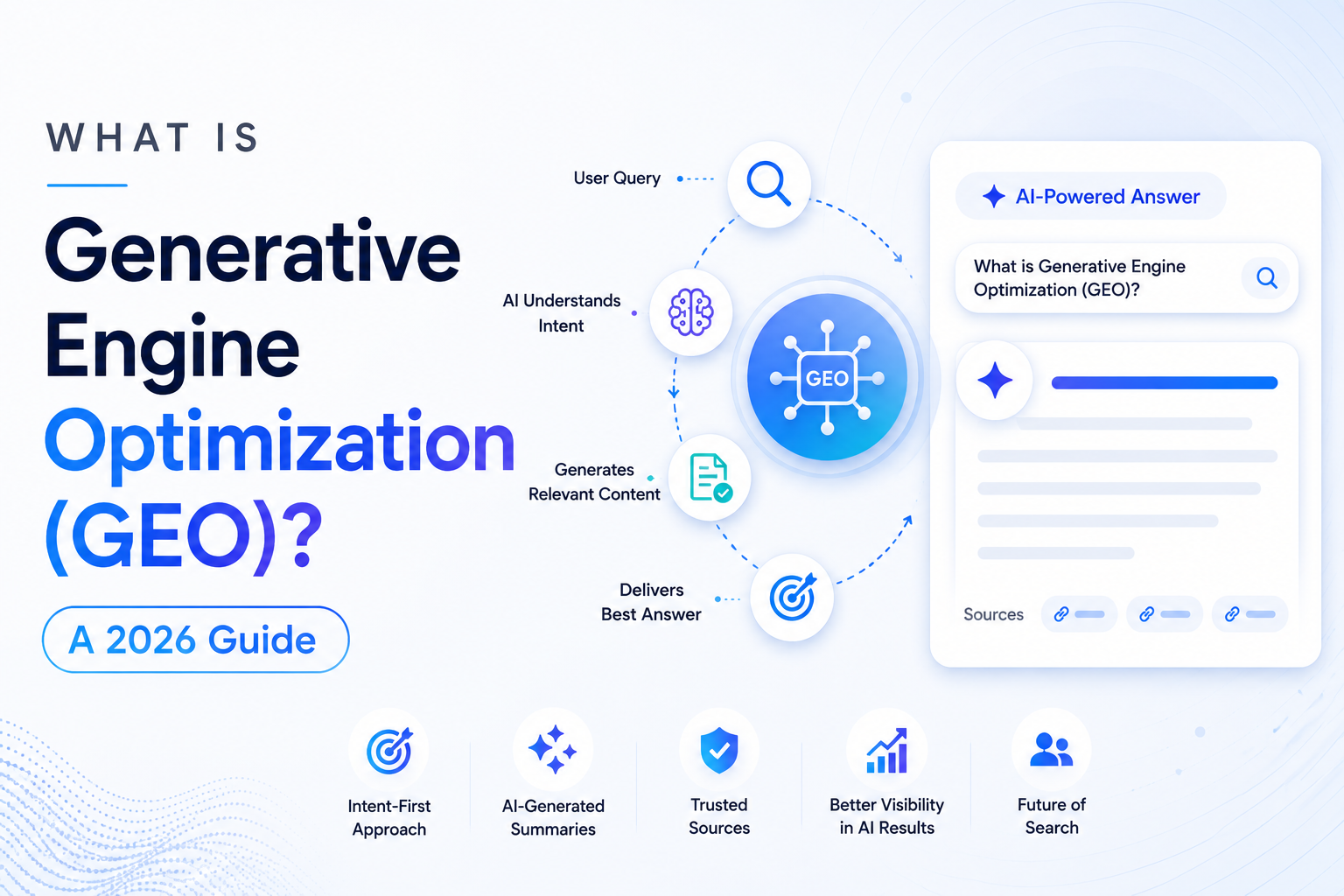
Generative Engine Optimization (GEO) is the practice of optimizing your content so generative AI systems — like ChatGPT, Google Gemini, Perplexity, and Google AI Overview — choose to cite it inside the answers they produce. Where traditional SEO aimed to win the click, GEO aims to win the citation: being one of the small handful of sources an AI engine actually names when it answers a user’s question.
For two decades, the goal of search marketing was unchanged: rank as high as possible on Google’s results page so people would click your link.
In 2026, that goal has shifted underneath everyone’s feet. The answer often appears above the links now — generated by an AI, drawn from a few hand-picked sources, and delivered in a single paragraph. The user reads it and moves on.
If your brand isn’t one of those hand-picked sources, you don’t exist in that moment. That’s the problem Generative Engine Optimization was created to solve.
Where the Term GEO Came From
GEO isn’t marketing jargon — it has academic roots. The term was formalized in a 2023 research paper out of Princeton and a coalition of other universities that studied how large language models choose which sources to cite when generating answers.
The researchers found something unexpected: the techniques that made a source more likely to be cited by a generative engine were not identical to the techniques that made a page rank well on Google. Things like citing statistics, including quotations from authorities, and using simpler language all moved the needle on citation rates — in ways that traditional SEO had never measured.
In other words: a new optimization discipline was needed, with its own playbook.
That discipline is GEO.
GEO vs SEO vs AI SEO: What’s Actually Different?
This is where most people get confused. The three terms sound interchangeable but they describe genuinely different things.
| Term | What It Optimizes For | Primary Surface |
| SEO (Traditional) | Ranking on the search results page | Google, Bing blue links |
| AI SEO | Both ranking AND citation across all AI-influenced search | Google + AI engines (umbrella term) |
| GEO | Specifically being cited inside generative AI answers | ChatGPT, Gemini, Perplexity, AI Overview |
Think of it this way:
-
- SEO is about being found.
-
- GEO is about being quoted.
-
- AI SEO is the umbrella that includes both.
A page can rank #1 on Google and still be ignored by Perplexity. A page can be cited by ChatGPT without ever ranking on Google at all. These are now independent outcomes — and each requires its own deliberate work.
How Generative Engines Actually Pick Their Sources
To do GEO well, you have to understand the mechanics. Every generative answer is assembled in three stages:
Stage 1: Retrieval
When you ask ChatGPT, Gemini, or Perplexity a question, the engine searches its underlying index — usually a combination of a live web search and its training data — and pulls a small set of candidate pages.
ChatGPT mostly retrieves through Bing. Gemini uses Google Search. Perplexity uses its own ranking layered over multiple sources. Despite the different plumbing, the pattern is the same: a shortlist of pages gets pulled in.
Stage 2: Ranking and Trust Scoring
Within that shortlist, the engine scores each page on factors like factual density, freshness, structural cleanliness, and the perceived authority of the source. Pages with clear answers, schema markup, and consistent brand signals score higher.
Stage 3: Synthesis and Citation
The model then writes an answer using fragments from the highest-scoring sources — and decides which ones to name in the output. Some get cited. Most don’t, even though their content quietly contributed to the answer.
GEO’s job is to win all three stages. Getting retrieved isn’t enough. Getting ranked isn’t enough. You have to be the source that gets named.
The GEO Playbook: 7 Tactics That Actually Move Citation Rates
These are the techniques most likely to increase how often generative engines quote you. They are also the ones least understood by traditional SEO teams.
1. Lead With the Answer
Every section of every page should open with a direct, extractable answer to a specific question. Buried answers don’t get lifted. Front-loaded answers do.
A useful rule: if a reader scanned only the first sentence of each section, would they still get the gist? If yes, you’ve written for GEO.
2. Cite Sources Inline
Counterintuitively, pages that cite other authoritative sources tend to get cited more themselves. This signals trust to the model and gives the engine a useful node in its knowledge graph.
Link to original research, official documentation, government sites, and peer-reviewed sources — not to other blog posts copying the same material.
3. Include Statistics and Specific Numbers
Generative engines reach for specific, citable data. “Conversion rates can improve significantly” gets ignored. “Conversion rates improve by an average of 23% after schema implementation” gets quoted.
When you have real data, use it. When you don’t, find a primary source that does and cite it.
4. Use Quotations and Named Experts
The Princeton research found that adding quotations from named experts measurably improved citation rates. Generative engines treat named, attributed quotes as anchor points of credibility.
A line like “According to [Expert Name], [specific claim]” is GEO gold.
5. Use Clearer, Simpler Language
Plain language outperforms jargon. The simpler your sentence structure, the easier it is for a model to extract a clean fragment and drop it into an answer. Long winding sentences with embedded clauses get skipped.
This is also where many enterprise content teams fail — overly formal corporate language is harder to extract than the same idea written in plain English.
6. Layer Schema Markup
Schema is the single highest-leverage technical move in GEO. Article, FAQPage, HowTo, Person, and Organization schema all give generative engines a structured, unambiguous read on your content.
FAQPage schema in particular has outsized impact, because Google AI Overview leans heavily on FAQ-structured content when assembling answers.
7. Strengthen Brand Entity Signals
LLMs don’t just read one page — they build a model of your brand across the entire open web. If your brand is described the same way on LinkedIn, Crunchbase, Wikipedia, your homepage, and a hundred small mentions, the model develops a confident picture of who you are. Confidence increases citation rates.
Inconsistent brand descriptions do the opposite: they confuse the model into not citing you at all.
What Doesn’t Work in GEO
A few tactics that traditional SEO teams instinctively reach for, but which underperform — or actively hurt — in GEO:
-
- Keyword stuffing. Generative engines retrieve by semantic intent, not by keyword density.
-
- Thin, high-volume publishing. Models don’t reward volume. They reward depth and clarity per page.
-
- Generic AI-written content with no specific data. It’s extractable on the surface but adds nothing the model couldn’t already generate itself — so it doesn’t get cited.
-
- Hiding the answer at the bottom for engagement metrics. Helpful for traditional time-on-page, harmful for citation.
-
- Over-optimizing for one engine. GEO works best when you optimize for the underlying patterns (entity clarity, factual density, schema) rather than chasing each engine’s quirks individually.
How to Measure GEO
This is the part most marketing teams haven’t built yet. There’s no equivalent to Google Search Console for AI engines — at least not yet. But you can measure GEO through a combination of signals:
-
- Manual citation tracking. Weekly, query ChatGPT, Gemini, and Perplexity with your target questions and log whether your brand appears. Tedious, but the most reliable signal you can get today.
-
- AI Overview appearances. Tools like Semrush, Ahrefs, and SE Ranking now track when your pages appear inside Google AI Overview.
-
- Referral traffic from AI engines. In GA4, watch for traffic sources like chatgpt.com, perplexity.ai, gemini.google.com, and copilot.microsoft.com. Growing referral traffic from these sources is a leading indicator.
-
- Branded search volume. When more people search your brand name, it usually means more AI engines are mentioning you in answers.
-
- Citation share of voice. For your target topics, what percent of AI answers include you vs. competitors? Track monthly.
How to Start Doing GEO Tomorrow
If you do nothing else, do these three things this week:
-
- Add FAQ sections with FAQPage schema to your highest-traffic pages. Highest-leverage move in GEO.
-
- Standardize your brand description across every external profile — your site, LinkedIn, Crunchbase, podcasts, author bios. Pick one sentence and freeze it.
-
- Rewrite your top 3 pages with the answer in the first paragraph, in plain English, with at least one cited statistic and one named expert.
These three moves alone will measurably improve your citation rate within a few weeks on most domains. The rest of the playbook builds from there.
Frequently Asked Questions
Is GEO the same as AI SEO?
They’re related but not identical. GEO specifically targets being cited inside generative AI answers. AI SEO is the broader umbrella that includes both traditional Google ranking and GEO. Most agencies use the terms interchangeably in casual conversation.
Does GEO replace SEO?
No. GEO builds on top of traditional SEO. The fundamentals — quality content, backlinks, technical health, crawlability — still matter because the same retrieval layer that feeds Google often feeds AI engines too. GEO adds new layers; it doesn’t remove old ones.
Which generative engines should I optimize for first?
For most businesses, the priority order is: Google AI Overview, ChatGPT, Perplexity, Gemini, Bing Copilot. AI Overview reaches the most users today. ChatGPT and Perplexity are growing the fastest as direct search replacements.
How long does GEO take to show results?
Most well-optimized pages start appearing in generative answers within 4–12 weeks, assuming the domain has at least minimal trust signals. New domains typically need 3–6 months to see consistent citations.
Do I need backlinks for GEO?
Yes, but the role has shifted. Backlinks still build domain trust. But for GEO, unlinked brand mentions across the open web matter almost as much — because LLMs learn from how often and how consistently your brand is described, not just who links to you.
What’s the single most impactful GEO change?
Adding FAQ sections with FAQPage schema to your high-intent pages. It directly improves AI Overview citation rates and takes only a few hours to implement.
Will GEO be a long-term discipline or a passing trend?
Long-term. AI-mediated search is now the default behaviour for hundreds of millions of users worldwide. The discipline will keep evolving as engines change, but the underlying need — being chosen by an AI to represent an answer — is permanent.
Ready to Get Cited by AI Engines?
Most websites are invisible inside ChatGPT, Gemini, and Perplexity right now — not because their content is bad, but because nobody has structured it for generative engines to find and trust.
SEO Mind Tech specializes in making brands AI-visible. Through entity strategy, schema deployment, content engineering, and citation tracking, we help brands win the new layer of search that traditional SEO can’t reach.
 Book a free AI Visibility Audit — we’ll show you exactly which AI engines are (and aren’t) citing your brand today, and what to fix first.
Get My Free AI Visibility Audit →