
AI SEO vs Traditional SEO: The Real Difference in 2026
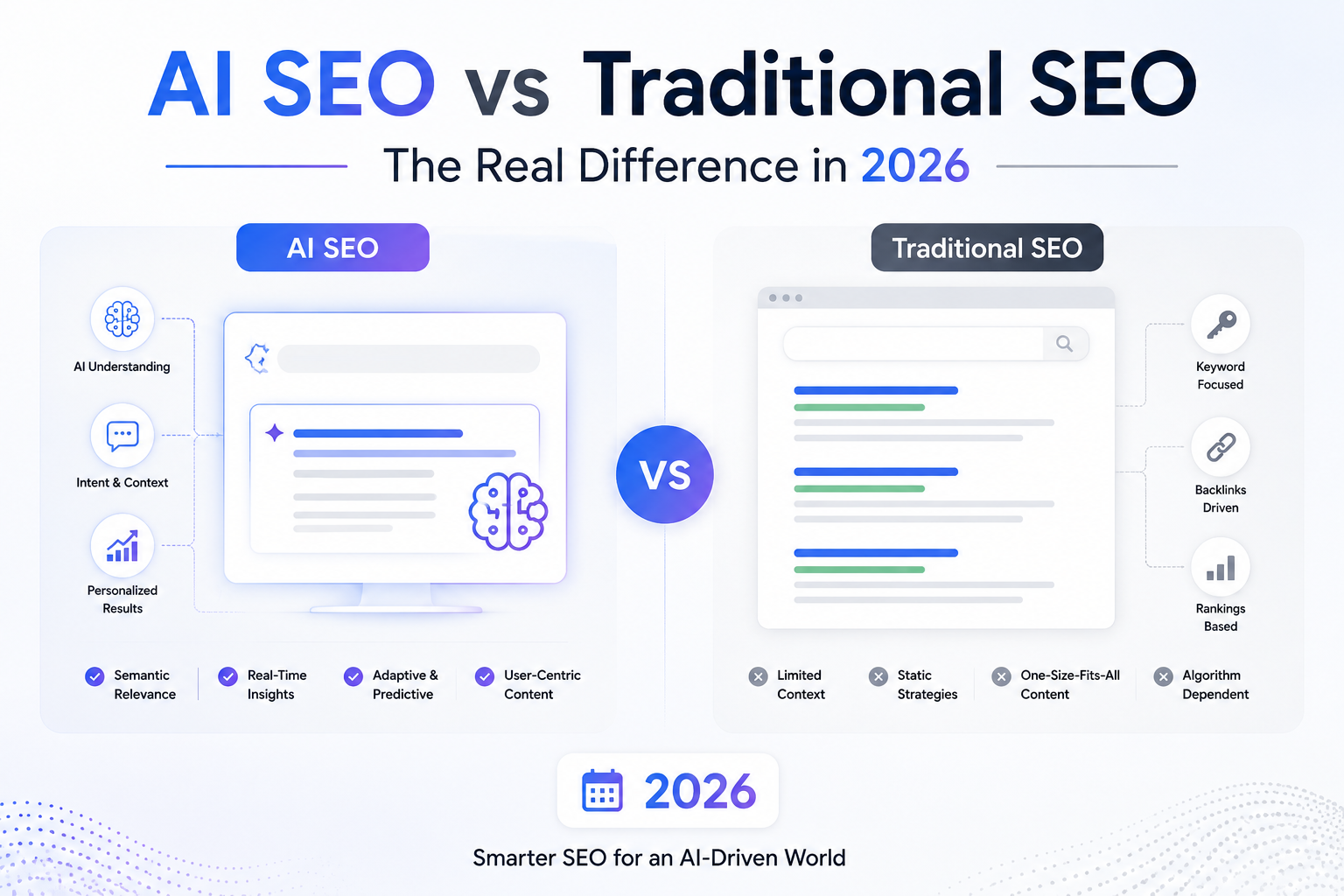
Traditional SEO is the practice of optimizing your website to rank in Google’s blue-link results. AI SEO is the practice of optimizing your website to be cited inside AI-generated answers on Google AI Overview, ChatGPT, Gemini, and Perplexity. They share many fundamentals — quality content, backlinks, technical health — but diverge sharply in how content is structured, what signals matter, and how success is measured. The brands winning in 2026 aren’t choosing between them. They’re doing both, deliberately.
There’s a quiet pricing problem in the marketing industry right now: agencies are charging for one thing and selling another.
Some are charging “AI SEO” rates while doing the same blue-link work they always did. Others are dismissing AI SEO as a fad and recommending traditional tactics that lost their edge eighteen months ago. Both approaches cost brands real money — either in fees that don’t move the needle, or in visibility that’s bleeding to competitors.
This article cuts through the confusion. By the end, you’ll know exactly what each discipline is, where they overlap, where they diverge, and which one (or both) your business actually needs.
The Core Difference in One Sentence
Traditional SEO is about being found. AI SEO is about being chosen.
In traditional SEO, success is a click. The user types a query, Google shows links, your link gets clicked, you win.
In AI SEO, success is a citation. The user types a query, an AI engine generates an answer, your brand is one of three to eight sources named in that answer, you win — even if no click happens at all.
These are not the same outcome. They require different content, different signals, and different success metrics.
The Full Comparison: 12 Dimensions
Most “AI SEO vs SEO” articles stop at a 5-row table. Here’s the actual depth.
| Dimension | Traditional SEO | AI SEO |
| Primary goal | Rank in top 10 blue links | Get cited inside AI-generated answers |
| Primary success metric | Rankings, organic clicks | Citations, AI Overview appearances, branded search lift |
| Content style | Keyword-targeted articles | Fact-dense, entity-rich, extractable answers |
| Content length | Often long (2,000–4,000+ words) | Often shorter but denser (1,200–2,000 with clear structure) |
| Authority signal | Backlinks | Backlinks + brand mentions across the open web |
| Technical focus | Crawling, indexing, Core Web Vitals | Same fundamentals + schema, entity clarity, AI extractability |
| Tools | Ahrefs, Semrush, Search Console | Same + AI citation trackers, Perplexity/ChatGPT testing, schema validators |
| Search engines targeted | Google, Bing | Google AI Overview + ChatGPT, Gemini, Perplexity, Copilot |
| Skills required | Keyword research, link building, on-page | Same + entity strategy, schema engineering, prompt-side testing |
| Time to first results | 3–9 months | 4–12 weeks for definitional content; 3–6 months for competitive topics |
| Audience surface | The search results page | The AI answer itself + the surrounding citation cards |
| ROI shape | Slow compounding clicks | Faster citation wins on long-tail + slow compounding entity authority |
That last row matters. AI SEO has a different ROI curve than traditional SEO. Wins arrive faster on niche, definitional content — but the durable brand-entity authority takes longer to build. Traditional SEO is the opposite: slow to start, steady to grow.
What Traditional SEO Still Gets Right (and Always Will)
It’s fashionable right now to declare traditional SEO dead. It isn’t. Several fundamentals carry directly into the AI search era — and any agency telling you otherwise is selling.
Technical health still matters. AI engines retrieve from the same crawled web that powers Google search. If your site can’t be crawled or indexed, no AI engine will find you either. Core Web Vitals, clean HTML, working XML sitemaps, mobile responsiveness — all still essential.
Backlinks still build authority. Both Google and the underlying retrieval layers that AI engines use weight backlinks as a trust signal. The marketing world has shifted to also valuing unlinked brand mentions, but that’s an addition to backlink strategy, not a replacement for it.
Keyword research still works. AI engines retrieve by intent, but intent is expressed through words. Mapping the question landscape — what users actually type — is as relevant as ever. The tooling has just expanded to include question research (AlsoAsked, AnswerThePublic) alongside traditional keyword research.
Quality content still wins. Thin, low-effort pages don’t rank in Google search and don’t get cited in AI answers. The bar is the same; the format requirements have evolved.
If anyone tells you traditional SEO is finished, they’re wrong. What’s true is that traditional SEO is no longer enough on its own.
What’s Genuinely New in AI SEO
These are the layers that didn’t exist in the traditional SEO playbook — or existed in form so different they’re effectively new.
Entity strategy. AI engines think in entities (people, brands, places, concepts) and the relationships between them. Defining your brand as a clear, consistent entity across every external profile is now a primary SEO task. It was barely a footnote in 2020.
Schema as a first-class signal. Schema markup existed before AI SEO, but it was a “nice to have” for rich snippets. In the AI era, schema is structural — it’s how engines understand what your content means. FAQPage schema alone has become one of the highest-leverage technical moves available.
Fact density and extractability. Traditional SEO tolerated long-winded prose if backlinks were strong. AI SEO punishes it. Pages need to lead with answers, structure content for fragment extraction, and pack specific data points into every section.
Brand mention engineering. LLMs learn from the open web — LinkedIn, Reddit, podcasts, Quora, niche publications, comment threads. How consistently and how often your brand is described across the web now influences whether AI engines trust you enough to cite you. This is a new discipline that didn’t exist in the link-building era.
Citation tracking and answer-share monitoring. Traditional SEO measured rank position. AI SEO adds a new question: how often does our brand appear in AI answers for our target topics? This is a manual, evolving practice — there’s no perfect Search Console for it yet — but it’s the metric that matters most.
What’s Actually Dead
Some tactics aren’t just less effective. They’re actively harmful in 2026.
- Keyword stuffing. AI engines retrieve by semantic intent. Stuffing kills extractability and trips quality classifiers.
- Exact-match anchor obsession. Both Google and LLMs reward natural language anchors. Repeated exact-match anchors look manipulative.
- Thin content at scale. Publishing 50 shallow posts a month worked briefly in the 2010s. It hurts now — both directly (Google quality classifiers) and indirectly (AI engines avoid citing thin sources).
- Pure keyword-density optimization. Word frequency hasn’t been the dominant signal for years. AI engines especially read meaning, not occurrence.
- Hiding the answer for engagement metrics. Stretching the answer to paragraph six to inflate time-on-page kills AI extraction. The page loses citation, even if engagement metrics tick up.
- One-and-done content strategy. AI engines decay old content fast. Pages updated quarterly out-cite pages published once and abandoned.
If your current SEO retainer is built around any of the above, the budget isn’t doing what you think it is.
Which One Should YOUR Business Focus On?
There’s no universal answer. The right mix depends on your business model and where your buyers actually search. Here’s an honest scenario breakdown.
New website, building from zero. Both, with AI SEO leading. Definitional AI SEO content gets indexed and cited faster on new domains than traditional SEO tactics produce rankings. This is the rare moment where AI SEO offers a speed advantage.
Established website losing visibility to AI Overview. Heavy AI SEO. The traffic loss isn’t because your traditional SEO broke — it’s because AI Overview is answering for you. Audit which queries are now triggering AI Overview, find out who’s getting cited, and engineer your content to displace them.
Local service business (plumber, dentist, salon, agency). Traditional SEO and Google Business Profile optimization still produce the bigger lever for now. AI SEO matters, but local queries trigger AI Overview less often than informational ones. Don’t ignore AI SEO — but don’t lead with it.
B2B SaaS or consultancy. AI SEO is critical. Your buyers research extensively through ChatGPT and Perplexity before talking to sales. If those engines don’t know your brand, you’re losing deals before the first call. Lead with AI SEO; supplement with traditional.
E-commerce. Both matter equally, but in different ways. Product pages need traditional SEO (rankings drive transactional traffic). Buying-guide content needs AI SEO (research queries are increasingly AI-mediated). Build infrastructure for both.
Publisher or content site. Brutal honesty: AI Overview is the existential threat here. AI SEO isn’t optional — it’s survival. The publishers thriving in 2026 are the ones who became citation-worthy sources for AI engines.
The Real Answer: They’re Not Competitors
The cleanest way to think about this:
Traditional SEO is the foundation. AI SEO is the new floor built on top.
Brands that ignore traditional SEO can’t rank in regular search, which means they can’t enter the AI retrieval pool, which means AI engines never see them. Brands that ignore AI SEO get found by Google but ignored by the AI answer layer that increasingly mediates what users actually read.
The agencies winning for their clients right now are doing both, integrated into one workflow — not bolting “AI SEO” onto a traditional retainer as a line item.
This is also why “AI SEO agencies” and “traditional SEO agencies” will probably stop being separate categories within a few years. The discipline is consolidating. What used to be SEO is now just search — and search now includes AI answers.
Frequently Asked Questions
No. The fundamentals — technical health, quality content, backlinks, keyword research — are still essential and feed directly into AI SEO. What’s dead are tactics like keyword stuffing, thin content at scale, and exact-match anchor manipulation. The discipline has evolved, not disappeared.
Not effectively. AI engines retrieve from the same crawled web that powers Google. If your site can’t be indexed, ranked, or trusted at the traditional layer, AI engines won’t find it either. Traditional SEO is the entry ticket.
Both, in different proportions depending on your business model. Informational and B2B content leans more toward AI SEO. Local and transactional content leans more toward traditional SEO. The honest answer is: stop choosing — integrate them.
Traditional SEO measures rankings, organic clicks, impressions, and conversion rate. AI SEO adds citation tracking across ChatGPT, Gemini, and Perplexity; AI Overview appearance frequency; AI engine referral traffic in GA4; and branded search volume as a proxy for AI mentions.
Some. Traditional tools (Ahrefs, Semrush, Search Console) remain essential. New tooling layers on top: AI Overview trackers in Semrush/Ahrefs, manual citation testing in Perplexity and ChatGPT, schema validators, and GA4 customizations to track AI engine referrals.
It will replace agencies that didn’t evolve. The discipline is consolidating into one practice — modern search optimization that includes both blue-link rankings and AI citations. Agencies offering only one half will struggle.
Definitional and long-tail content can produce citations within 4–12 weeks on new domains. Competitive head-term citation typically takes 3–6 months. Brand-entity authority — the durable kind — compounds over 6–18 months. Faster than traditional SEO on the front end; slower on the deep end.
Ready to Stop Choosing — and Start Doing Both?
If your current SEO strategy is built around traditional tactics alone, you’re losing visibility every week to brands that have layered AI SEO on top. If you’ve jumped to “pure AI SEO” without the fundamentals, you’re not even entering the retrieval pool that AI engines draw from.
SEO Mind Tech integrates both into a single, predictable growth engine. We audit, plan, and execute across traditional SEO fundamentals and AI SEO layers — so your brand ranks on Google and gets cited by AI engines.
👉 Book a free AI Visibility Audit — we’ll show you exactly how your current SEO performs across both Google’s blue links and the AI answer layer, and what to fix first.
Get My Free AI Visibility Audit →