

How to Rank in Google AI Overview: 9 Practical Steps (2026 Guide)
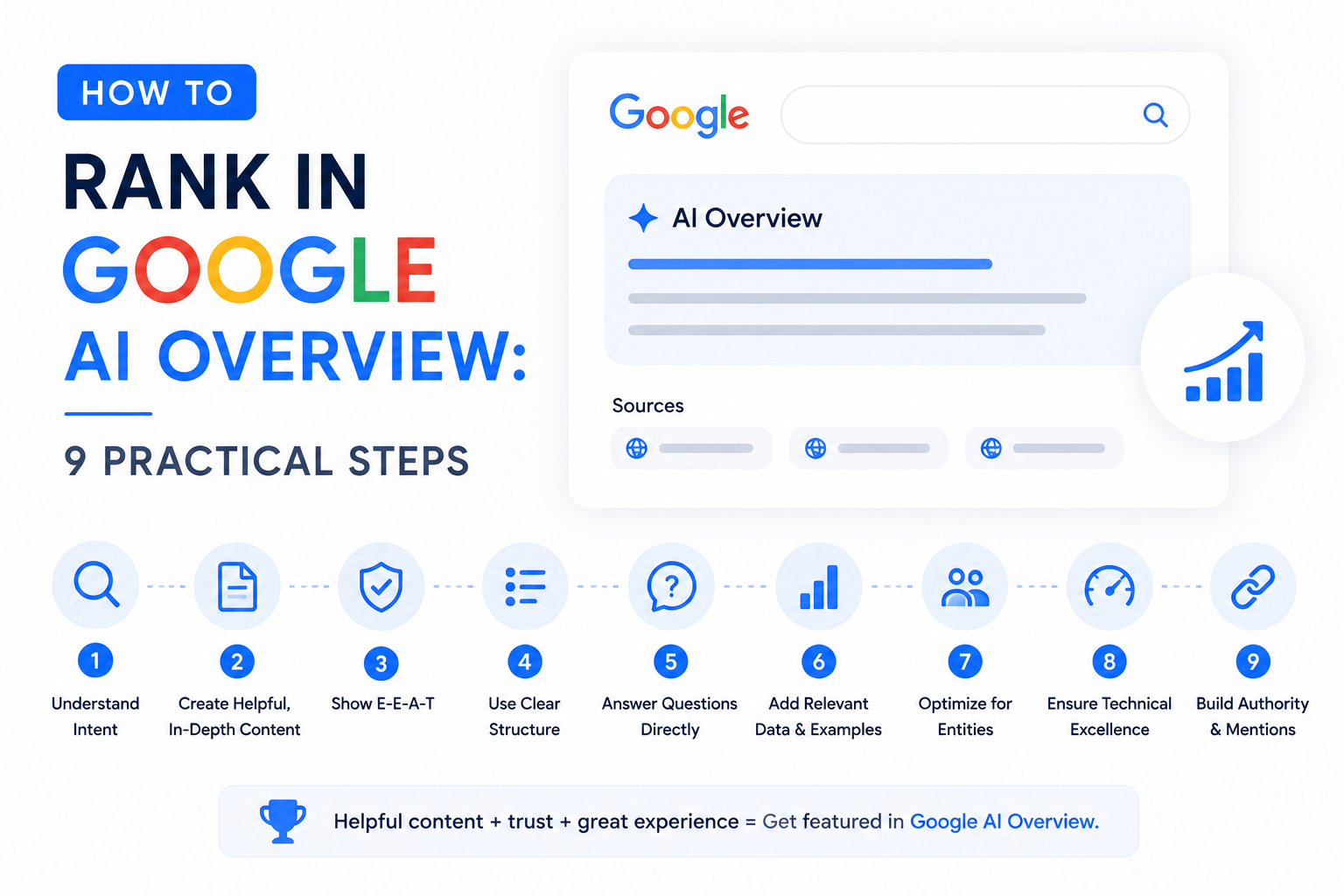
Ranking in Google AI Overview requires more than traditional SEO. Google now prioritizes content that demonstrates expertise, answers user intent clearly, is backed by credible sources, and is structured for AI systems to understand. By focusing on EEAT, entity SEO, structured data, topical authority, and high-quality content, you can significantly increase your chances of being cited in AI-generated search results.
Google Search Has Changed
Google Search is evolving faster than ever. With the introduction of AI Overview, users no longer need to visit multiple websites to find answers. Instead, Google’s AI summarizes information from trusted sources and presents it directly at the top of the search results.
For businesses and website owners, this means ranking on the first page alone is no longer enough. If your content isn’t optimized for AI-generated results, you could lose valuable visibility and traffic.
The good news? AI Overview still relies on high-quality websites to generate its answers. If your content is authoritative, well-structured, and helpful, your website has a strong opportunity to become one of those trusted sources.
In this guide, we’ll walk through 9 practical steps to help your content rank in Google AI Overview in 2026.
Why Google AI Overview Matters in 2026
Google AI Overview is changing how users interact with search results.
Instead of reading multiple articles, users receive summarized answers generated from trusted websites. Websites cited in these summaries often experience increased visibility, stronger brand authority, and higher click-through rates.
Optimizing for AI Overview also prepares your website for AI-powered search platforms such as ChatGPT, Perplexity AI, and Microsoft’s Copilot.
Simply put, AI SEO is becoming just as important as traditional SEO.
9 Practical Steps to Rank in Google AI Overview
1. Create Content That Fully Answers Search Intent
Google AI prefers content that completely solves a user’s query instead of partially answering it.
Before writing, understand what users actually want to know and cover the topic from every angle.
Include:
- Clear definitions
- Step-by-step explanations
- Examples
- Benefits
- Common mistakes
- Frequently asked questions
Comprehensive content gives AI more confidence when selecting sources.
2. Demonstrate EEAT
Google continues to reward websites that demonstrate:
- Experience
- Expertise
- Authoritativeness
- Trustworthiness
Include author information, real examples, original insights, client case studies, and trustworthy references wherever appropriate.
Businesses with strong credibility are more likely to appear in AI-generated answers.
3. Organize Content for AI Readability
AI systems understand structured content much better than long walls of text.
Use:
- H2 and H3 headings
- Bullet points
- Numbered lists
- Short paragraphs
- Tables where appropriate
- Summary sections
A clean structure helps Google identify important information quickly.
4. Build Topical Authority
Publishing one article isn’t enough anymore.
Google trusts websites that consistently cover an entire topic.
For example, if your website focuses on SEO, create supporting articles such as:
- What is Google AI Overview?
- AI SEO vs Traditional SEO
- Generative Engine Optimization Guide
- EEAT Best Practices
- Technical SEO for AI Search
These interconnected articles strengthen your topical authority.
5. Use Structured Data
Schema markup helps Google understand your content better.
Depending on the page, implement:
- Article Schema
- FAQ Schema
- Organization Schema
- Breadcrumb Schema
- HowTo Schema
Structured data increases the chances of your content being interpreted correctly by AI systems.
6. Strengthen Your Brand Entity
Google increasingly relies on entity recognition instead of just keywords.
Ensure your business information is consistent across:
- Website
- Google Business Profile
- X (Twitter)
- YouTube
- Business directories
Consistency helps Google understand your brand as a trusted entity.
7. Earn High-Quality Backlinks
Backlinks remain one of Google’s strongest trust signals.
Focus on earning links from:
- Industry blogs
- News websites
- Guest posts
- Business directories
- Relevant niche publications
Quality matters far more than quantity.
8. Keep Your Content Fresh
Google favors content that reflects current information.
Review your important pages every few months by:
- Updating statistics
- Adding new examples
- Refreshing screenshots
- Expanding sections
- Improving readability
Fresh content signals ongoing expertise and relevance.
9. Improve User Experience
Even the best content struggles if users have a poor experience.
Optimize your website for:
- Fast loading speed
- Mobile responsiveness
- Clear navigation
- HTTPS security
- Easy readability
- Internal linking
A better user experience supports stronger rankings across both traditional search and AI Overview.
Common Mistakes to Avoid
Many websites fail to appear in AI Overview because they:
- Write only for keywords instead of users
- Publish thin or duplicate content
- Ignore EEAT principles
- Skip schema markup
- Have poor website performance
- Build weak topical authority
- Use outdated information
- Focus only on rankings instead of user experience
Avoiding these mistakes can significantly improve your AI search visibility.
Traditional SEO vs AI Overview SEO
| Traditional SEO | AI Overview SEO |
| Focuses on keyword rankings | Focuses on complete answers |
| Optimizes individual pages | Builds topical authority |
| Relies heavily on backlinks | Combines authority, trust, and relevance |
| Prioritizes rankings | Prioritizes citations and visibility |
| Keyword optimization | Entity optimization and EEAT |
The future of SEO is combining both strategies rather than choosing one over the other.
Frequently Asked Questions
What is Google AI Overview?
Google AI Overview is an AI-powered search feature that summarizes information from multiple trusted websites to answer user queries directly in search results.
Can small websites rank in AI Overview?
Yes. Small websites with high-quality, authoritative, and well-structured content can be cited by Google AI Overview.
Does schema markup help AI Overview?
Yes. Schema helps Google understand your content more accurately, making it easier for AI systems to interpret your pages.
How long does it take to appear in AI Overview?
There is no fixed timeline. Websites with strong authority, quality content, and proper optimization may begin appearing as Google reprocesses and indexes updated content.
Is AI Overview replacing traditional SEO?
No. Traditional SEO remains essential, but AI optimization is becoming an important extension of modern SEO strategies.
Final Thoughts
Google AI Overview represents one of the biggest shifts in search in recent years. Businesses that adapt early by creating authoritative, well-structured, and genuinely helpful content will be better positioned to earn visibility across AI-powered search experiences.
Instead of chasing keywords alone, focus on becoming the most trusted source on your topic. Build topical authority, strengthen your brand entity, improve user experience, and publish content that truly answers users’ questions. These strategies not only improve your chances of appearing in AI Overview but also strengthen your overall SEO performance.
Ready to Rank in Google AI Overview?
At SEO Mind Tech, we help businesses prepare for the future of search with AI-driven SEO strategies, Generative Engine Optimization (GEO), technical SEO, content optimization, and authority building.
Whether you’re looking to improve your organic rankings or increase your chances of being featured in Google AI Overview, our team can create a tailored strategy that delivers long-term results.
Contact SEO Mind Tech today and discover how AI-powered SEO can help your business stay ahead of the competition.