

What Is Entity SEO and Why It Matters in 2026
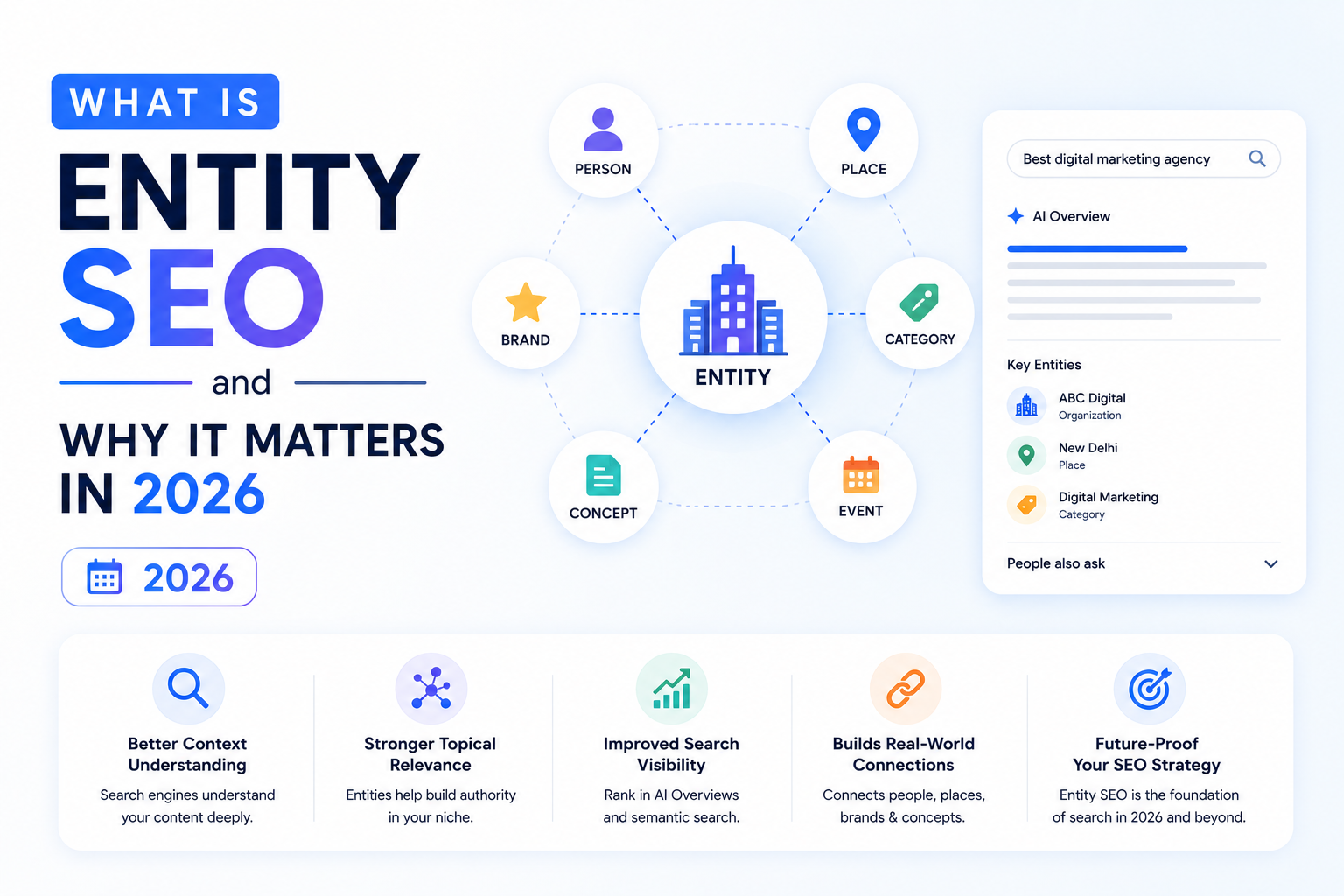
Entity SEO is the practice of optimizing how Google and AI engines understand what your brand is — not just which keywords your pages target. Search systems no longer think in strings of text; they think in entities (people, brands, places, concepts) and the relationships between them. Entity SEO builds your brand into a clear, recognized entity through schema, consistent descriptions, authoritative profile links, and Knowledge Graph signals — making it easier for Google to rank you, for AI Overview to cite you, and for ChatGPT, Gemini, and Perplexity to describe you accurately.
Most SEO work in 2026 still looks like SEO work from 2015: keyword research, keyword targeting, keyword tracking, keyword reports.
But search engines stopped thinking that way more than a decade ago. Google’s Knowledge Graph went live in 2012. Hummingbird, RankBrain, BERT, and MUM each pushed the underlying technology further from keywords and closer to meaning. Today’s AI engines — ChatGPT, Gemini, Perplexity — were built entity-first from day one.
The marketers who keep optimizing for keywords are working on the wrong layer of the system. Entity SEO is how you work on the right one.
This guide explains what entities actually are, why they’ve become the foundation of modern search, and exactly how to build your brand into one.
The Big Shift: From Keywords to Entities
For most of SEO’s history, search worked like a giant text-matching system. You typed words; Google found pages with those words; the page with the best signals around those words won.
That world ended quietly, in stages, over the past fifteen years.
- 2012: Google launched the Knowledge Graph — a structured database of real-world entities (people, places, organizations, things) and how they connect to each other.
- 2013: Hummingbird shifted ranking toward query intent, not just keyword matching.
- 2018: BERT taught Google to understand context and relationships between concepts.
- 2022: MUM and other multitask AI systems began reasoning across entities and topics.
- 2024–2026: Gemini, ChatGPT, and Perplexity made entity-first search the default user experience.
Through all of this, marketing tools kept reporting on keywords because keywords are still how people describe searches. But the underlying system stopped operating on keywords years ago. It operates on entities — and entity SEO is how you finally optimize for the system as it actually works.
What Is an Entity? In Plain English
An entity is anything specific and identifiable: a person, an organization, a place, a product, a concept, an event.
Entities have two important properties:
1. Attributes — facts about the entity. Example: SEO Mind Tech is an Organization. Founded in [year]. Headquartered in [location]. Provides AI SEO, performance marketing, and web development services.
2. Relationships — connections to other entities. Example: SEO Mind Tech (Organization) has founder (Person). SEO Mind Tech has profile on (LinkedIn). SEO Mind Tech operates in (digital marketing industry).
When you type a question into Google or ChatGPT, the system isn’t matching your words to pages. It’s identifying which entities your question is about, retrieving what it knows about those entities, and using that to answer.
If your brand isn’t recognized as a clear entity, you’re invisible at that layer. Your pages might still rank for some keyword queries, but you won’t appear in the structured answers that increasingly dominate search.
Why Entity SEO Matters More in 2026
Three forces have compounded to make entity work the single highest-leverage shift in modern SEO.
1. AI engines are entity-first by design. Large language models don’t think in strings of text the way old search engines did. They embed entities into vector spaces, learn relationships between them, and reason about how entities connect. A brand that’s a fuzzy concept to an LLM gets vague treatment. A brand that’s a sharp, well-defined entity gets cited accurately and consistently.
2. Knowledge panels are now AI Overview anchors. The “knowledge panel” that appears on the right side of Google search results — and the entity boxes embedded inside AI Overview — both pull from Google’s Knowledge Graph. Brands with strong entity signals get knowledge panels; brands without them don’t. And knowledge panels significantly boost click-through rates and AI citation frequency.
3. Brand entity strength predicts AI citation rate. Whether ChatGPT cites your brand for a topic isn’t decided by your domain authority alone. It’s decided by how consistently and how thoroughly the model has learned what your brand is. That learning happens at the entity level — across your site, your schema, your profiles, your mentions across the web.
The pattern is straightforward: clear entity → confident model → frequent citation. Fuzzy entity → uncertain model → quiet treatment.
The 5 Pillars of Entity SEO
A complete entity SEO program rests on five pillars. Each builds on the last.
Pillar 1: Brand Entity Definition
Before any technical work, define your brand as an entity in one sentence — and use that exact sentence everywhere.
Example for SEO Mind Tech:
SEO Mind Tech is an AI-powered digital growth agency helping businesses rank on Google and get cited in AI search through SEO, AI visibility, web development, and performance marketing.
This single sentence belongs on your homepage, your About page, your LinkedIn description, your Crunchbase profile, your podcast bios, your author blocks. Variation is normal in surrounding copy. The core sentence stays identical.
AI engines learn from consistency. Variation creates uncertainty.
Pillar 2: Sitewide Organization Schema with sameAs
Organization schema declares your brand as an entity. The sameAs property declares which external profiles belong to that entity — your LinkedIn page, X account, YouTube channel, Crunchbase profile, Wikipedia entry (if you have one).
This is how you connect your brand into the Knowledge Graph. Without it, Google has to guess which “[Your Brand Name]” entries across the web are actually you. With it, you remove the guesswork.
A complete sameAs block typically includes:
- LinkedIn company page
- X / Twitter profile
- YouTube channel
- Facebook page
- Instagram profile
- Crunchbase entry
- Wikidata identifier
- Wikipedia URL (if applicable)
- Google Business Profile URL
- Industry-specific directories where you have presence
Pillar 3: External Profile Consistency
Every external profile is a vote for your entity. Inconsistency between them weakens the signal.
What needs to match across all profiles:
- Brand name (exact spelling, capitalization, and spacing)
- One-sentence description (the one from Pillar 1)
- Logo (same file, same colors, same proportions)
- Founding year
- Headquarters location
- Primary website URL
- Industry category
Most brands fail this audit. They have three slightly different descriptions, two logo variants, and an inconsistent category across LinkedIn, Crunchbase, and their own footer. Fix this once and visibility improves across every AI engine simultaneously.
Pillar 4: Wikidata Entry
Wikidata is the open-source structured data layer behind Wikipedia — and a primary source for Google’s Knowledge Graph and most major LLM training datasets.
A Wikidata entry for your business creates a structured, machine-readable identity that flows directly into how AI engines understand you. The barrier to entry is moderate (Wikidata requires verifiable references) but the payoff is significant: brands with Wikidata entries get cited and described more accurately by every major AI engine.
Not every business qualifies. The notability bar is real. But for agencies, B2B brands, and growing companies with a few media mentions, qualifying is more achievable than people assume.
Pillar 5: Person Entities for Founders and Authors
Brand entities work better when they’re connected to person entities.
Every author bio on your site should have:
- Person schema with name, job title, organization, social profiles
- A real headshot
- Real credentials, certifications, and notable work
- sameAs links to LinkedIn, X, Google Scholar (if applicable), and any other authoritative profiles
Same for founders, executives, and recurring contributors. AI engines pull author identity into trust scoring — and a page authored by a recognized person entity outperforms a page authored by “Admin” or “Editorial Team.”
How to Build Your Brand into an Entity (Step by Step)
The execution sequence that actually works:
- Lock the one-sentence brand description. Don’t move forward until this is decided.
- Update every external profile — LinkedIn, Crunchbase, Facebook, YouTube, Instagram, industry directories — to use the locked description, matched logo, and consistent name/category.
- Add Organization schema sitewide with sameAs to every profile from step 2.
- Add Person schema to every author bio, founder page, and team page.
- Build author authority — get your founders quoted in industry publications, on podcasts, in HARO responses.
- Apply for Wikidata once you have 3–5 independent, citable references.
- Aim for Wikipedia longer-term — usually 18–36 months out for most brands, but worth the strategic patience.
- Audit quarterly — entity signals decay if profiles drift out of sync.
This is a 90-day setup followed by ongoing maintenance, not a one-week project.
Common Entity SEO Mistakes
These are the patterns that kill entity strength even when individual pieces are technically in place.
- Three different brand descriptions across the homepage, LinkedIn, and Crunchbase. Pick one. Use it everywhere.
- Organization schema with no sameAs links. This is the most common partial implementation. It declares the entity but doesn’t connect it. Always include sameAs.
- Author bios marked up as Person schema with no real credentials. Empty Person schema is worse than no schema — it triggers EEAT classifiers without delivering substance.
- Inconsistent capitalization and spacing in the brand name. “SEO Mind Tech,” “SeoMindTech,” and “Seo Mind Tech” register as three separate strings. Lock one and stay strict.
- Treating entity SEO as a one-time schema project. Profiles drift, services evolve, team changes. Entity SEO is maintenance work, not a launch deliverable.
- Ignoring competitor entity comparisons. If your competitors have Wikidata entries and you don’t, that’s a measurable disadvantage you can address.
Frequently Asked Questions
Entity SEO is the practice of making your brand recognizable to search engines and AI systems as a clear, identifiable entity — a specific organization with attributes and relationships — rather than just a website with keyword-targeted pages.
Yes. Regular SEO optimizes pages around keywords and target queries. Entity SEO optimizes your brand identity across schema, external profiles, and the Knowledge Graph. Both are needed; they work on different layers of the system.
No. Keywords are still how users express intent, so keyword research remains essential for content planning. Entity SEO operates underneath that — making sure Google and AI engines know who you are when your content shows up in their results.
Adding sitewide Organization schema with a complete sameAs block linking to every authoritative profile your brand has across the web. This single move connects your site to the Knowledge Graph and improves AI engine recognition across every platform at once.
Schema-level changes are picked up within days. Knowledge panel appearance typically takes 1–6 months depending on your existing footprint. Wikidata acceptance can take weeks. Full entity authority — the kind that meaningfully shifts AI citation rates — compounds over 6–18 months.
Yes — possibly more than large ones. Big brands are entities by default because they’re widely written about. Small businesses have to deliberately build their entity presence. The good news is that for small businesses, entity SEO is one of the fastest ways to punch above your weight in AI search.
More. As search becomes more AI-mediated, the entity layer becomes more decisive. Every major search trend points the same direction: away from keyword strings and toward structured understanding of brands, people, and concepts.
Ready to Build Your Brand into a Recognized Entity?
Most websites have decent on-page SEO and broken entity signals. The result: they rank for some queries, but disappear inside AI Overview, ChatGPT, and Perplexity — because those systems don’t know what to make of them.
SEO Mind Tech specializes in entity SEO and AI visibility. We audit your current entity footprint, deploy schema, align external profiles, and build your brand into the kind of clear, recognized entity that AI engines confidently cite.
👉 Book a free AI Visibility Audit — we’ll show you exactly where your brand stands as an entity today, what’s missing, and what to fix first.
Get My Free AI Visibility Audit →